


Last Updated: January 18, 2026 | Reading Time: 22 minutes | Author: MyMoveSpain Immigration Team
“Do I need a visa for Spain?” is one of the most common questions travellers and future residents ask before planning their Spanish journey, and the answer depends on your nationality, purpose of visit, and length of stay. Whether you’re planning a beach vacation on Costa del Sol, moving to Spain for work, studying in Barcelona, or retiring to Málaga, understanding Spain’s visa requirements is essential.
The good news? Many nationalities don’t need a visa for short tourist visits to Spain. However, if you’re planning to stay longer than 90 days, work, study, or establish residency in Spain, you’ll need to navigate Spain’s visa system. Spain is part of the Schengen Area, which means that visa rules are standardised across 27 European countries; however, there are specific Spanish visa requirements for long-term stays.
With over 500 successful client cases, we have a deep understanding of which nationalities require a visa for Spain, the necessary documents, and how to avoid common application errors. In this comprehensive 2026 guide, we’ll answer “Do I need a visa for Spain?” for every nationality, explain all Spain visa types, detail requirements, walk you through the application process, and provide expert tips to maximise your approval chances.
Quick Answer: Do You Need a Visa for Spain?
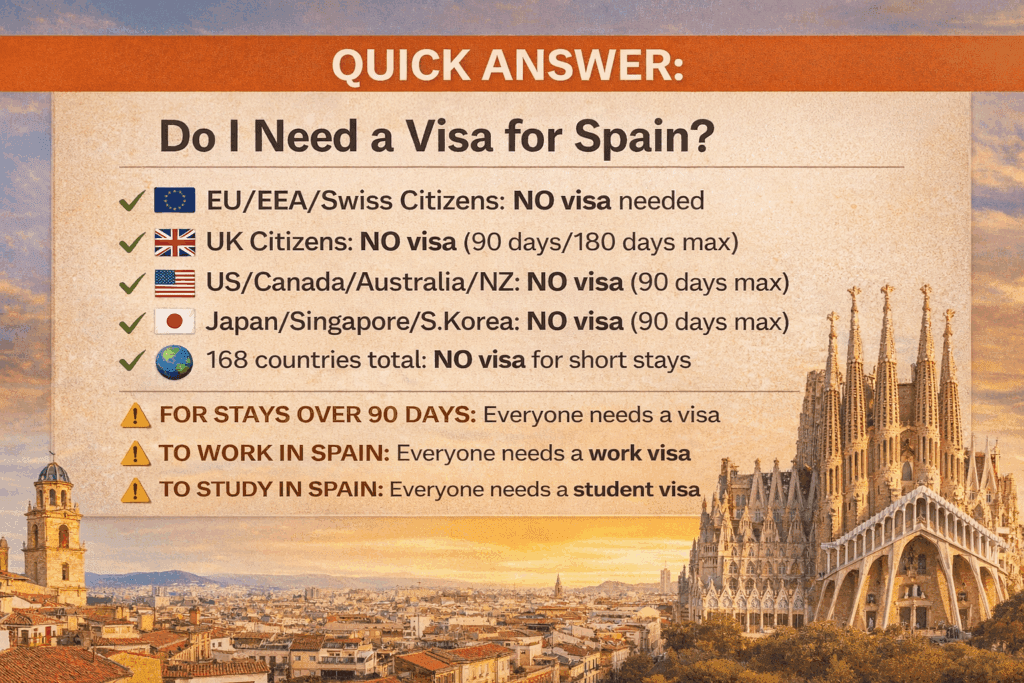
The simple answer: Whether you need a visa for Spain depends on three factors:
- Your Nationality – EU citizens have freedom of movement; 168 countries have visa-free access for tourism
- Purpose of Visit – Tourism, work, study, or residency requires different visas
- Length of Stay – Stays under 90 days (tourism) vs. over 90 days (long-term) have different rules
Here’s the breakdown:
- EU/EEA/Swiss citizens: You do NOT need a visa for Spain. You have the right to live and work freely.
- UK citizens (post-Brexit): You do NOT need a visa for tourist visits up to 90 days within any 180 days. For longer stays, you need a Spanish residency visa.
- Visa-waiver countries (US, Canada, Australia, etc.): You do NOT need a visa for tourist visits up to 90 days. Spain is part of the Schengen visa waiver program.
- All other nationalities: Check the complete list below to see if you need a visa for Spain.
Important Note: Even if you don’t need a visa for short tourist stays, you WILL need a visa if you want to:
- Stay in Spain longer than 90 days
- Work in Spain (employed or self-employed)
- Study in Spain for more than 90 days
- Establish permanent residency in Spain
- Retire to Spain
Let’s dive into exactly who needs a visa for Spain and which type of visa you need based on your situation.
[VISUAL ELEMENT 1: Decision Tree Flowchart] Alt text: “Do I need a visa for Spain decision tree – determine Spain visa requirements by nationality and purpose”
Flowchart Structure:
Start: Are you planning to visit Spain?
↓
Are you an EU/EEA/Swiss citizen?
→ YES → No visa needed ✅
→ NO ↓
Is your country on the visa-waiver list?
→ YES → Is your stay under 90 days for tourism?
→ YES → No visa needed ✅
→ NO → Need long-stay visa ⚠️
→ NO → Need Schengen tourist visa ⚠️
Who Doesn’t Need a Visa for Spain? (Visa-Free Countries)
If you’re wondering, “Do I need a visa for Spain?”, the answer is NO for citizens of 168 countries who can visit Spain visa-free for short stays. Here’s the complete breakdown:
🇪🇺 EU/EEA/Swiss Citizens (Freedom of Movement)
Citizens of the following countries have unlimited freedom to live, work, and stay in Spain without any visa:
EU Member States (27 countries): Austria, Belgium, Bulgaria, Croatia, Cyprus, Czech Republic, Denmark, Estonia, Finland, France, Germany, Greece, Hungary, Ireland, Italy, Latvia, Lithuania, Luxembourg, Malta, Netherlands, Poland, Portugal, Romania, Slovakia, Slovenia, Spain, Sweden
EEA Countries: Iceland, Liechtenstein, Norway
Special Status: Switzerland
What this means:
- ✅ You can stay in Spain indefinitely
- ✅ You can work in Spain without a work permit
- ✅ You can study in Spain
- ✅ You only need to register for residency after 3 months
- ✅ You have the same rights as Spanish citizens for healthcare and social security
No visa needed, no time limits, complete freedom.
🇬🇧 UK Citizens Post-Brexit (90/180-Day Rule)
Do UK citizens need a visa for Spain? No, but Brexit changed the rules.
UK nationals can visit Spain visa-free for up to 90 days within any 180 days for tourism, family visits, or short business trips.
The 90/180-Day Rule Explained:
- You can stay in Spain (and the entire Schengen Area) for 90 days
- These 90 days are calculated within a rolling 180-day period
- Example: If you spend 90 days in Spain from January-March, you cannot return until July (180 days later)
- The 90 days apply to ALL Schengen countries combined, not just Spain
What UK Citizens Can Do Visa-Free:
- ✅ Tourism and sightseeing
- ✅ Visiting family and friends
- ✅ Short business meetings and conferences
- ✅ Attending cultural or sports events
What UK Citizens CANNOT Do Visa-Free:
- ❌ Work in Spain (employed or self-employed)
- ❌ Stay longer than 90 days
- ❌ Establish residency
- ❌ Study for more than 90 days
For UK citizens wanting to live in Spain permanently, work, or stay longer than 90 days, you need a <a href=”/non-lucrative-visa-spain/”>Spanish residency visa such as the Non-Lucrative Visa</a> for retirement, <a href=”/digital-nomad-visa-spain/”>Digital Nomad Visa</a> for remote workers, or <a href=”/spain-work-permit/”>Spain work permit</a> for employment.
Learn more about moving to Spain from the UK →
🌎 Visa-Waiver Countries (Schengen Visa Waiver Program)
Citizens of 168 countries can visit Spain visa-free for tourism, family visits, or short business trips for up to 90 days within any 180 days.
Major Visa-Free Countries for Spain:
Americas:
- 🇺🇸 United States
- 🇨🇦 Canada
- 🇲🇽 Mexico
- 🇦🇷 Argentina
- 🇧🇷 Brazil
- 🇨🇱 Chile
- 🇨🇴 Colombia
- 🇨🇷 Costa Rica
- 🇺🇾 Uruguay
- 🇻🇪 Venezuela
Asia-Pacific:
- 🇦🇺 Australia
- 🇳🇿 New Zealand
- 🇯🇵 Japan
- 🇸🇬 Singapore
- 🇰🇷 South Korea (South)
- 🇲🇾 Malaysia
- 🇧🇳 Brunei
- 🇭🇰 Hong Kong
- 🇲🇴 Macau
- 🇹🇼 Taiwan
Middle East:
- 🇦🇪 United Arab Emirates
- 🇮🇱 Israel
- 🇰🇼 Kuwait
- 🇶🇦 Qatar
- 🇧🇭 Bahrain
Other Regions:
- 🇬🇪 Georgia
- 🇺🇦 Ukraine
- 🇷🇸 Serbia
- 🇦🇱 Albania
- 🇧🇦 Bosnia & Herzegovina
- 🇲🇰 North Macedonia
- 🇲🇪 Montenegro
Complete List of 168 Visa-Free Countries: View full list on the Official EU Website
Understanding the 90/180-Day Rule
This is the most important rule for visa-free visitors to Spain and the entire Schengen Area.
How It Works:
- Rolling 180-Day Period: Look back from today’s date for the past 180 days
- Maximum 90 Days: You cannot have spent more than 90 days in the Schengen Area during those 180 days
- All Schengen Countries Count: Days in Spain, France, Italy, Germany, etc., all count toward your 90-day limit
- Non-Schengen Countries Don’t Count: Days in the UK, Ireland, Croatia (before 2023), Romania, and Bulgaria don’t count
Example Calculation:
- January 1 – March 31: Spent 90 days in Spain (used full allowance)
- April 1 – June 30: Cannot enter Schengen Area (within 180 days of Jan 1)
- July 1: Can return (180 days have passed since Jan 1)
- July 1 – September 29: Can spend another 90 days
Common Mistakes:
- ❌ Thinking it’s “90 days per calendar year” (it’s not – it’s a rolling period)
- ❌ Thinking you can stay 90 days, leave for a week, and come back for 90 more days (you can’t)
- ❌ Not counting days spent in other Schengen countries (they all count together)
Calculate Your Days: Use the official Schengen Visa Calculator to track your days.
⚠️ Overstaying Consequences: Overstaying your visa-free period can result in:
- Entry bans (up to 5 years)
- Fines (€500-€10,000)
- Deportation
- Future visa rejections
What You Can and Cannot Do Without a Visa in Spain
✅ ALLOWED Activities (Visa-Free Visitors):
- Tourism and sightseeing
- Visiting family and friends
- Short business meetings and conferences
- Attending cultural, sports, or educational events
- Short-term medical treatment
- Transit through Spain to another destination
❌ NOT ALLOWED Activities (Visa-Free Visitors):
- Working in Spain (employed or self-employed)
- Studying for more than 90 days
- Establishing residency
- Volunteering (some exceptions for registered volunteers)
- Receiving payment for services in Spain
- Starting a business in Spain
- Staying longer than 90 days total
Important: If you plan to work remotely for a non-Spanish company while visiting Spain, technically, you need a Digital Nomad Visa. However, enforcement for remote workers on short trips is minimal.
Who Needs a Visa for Spain? (Countries Requiring Visas)
If your country is not on the visa-free list above, you need a visa for Spain, even for short tourist visits.
Countries That Need a Tourist Visa for Spain
Citizens from approximately 100 countries must obtain a Schengen tourist visa before travelling to Spain for any purpose, including tourism.
Major Countries Requiring Spain Tourist Visa:
Asia:
- 🇨🇳 China
- 🇮🇳 India
- 🇵🇭 Philippines
- 🇮🇩 Indonesia
- 🇻🇳 Vietnam
- 🇹🇭 Thailand (visa-free for 90 days effective 2024)
- 🇵🇰 Pakistan
- 🇧🇩 Bangladesh
- 🇱🇰 Sri Lanka
- 🇳🇵 Nepal
Africa:
- 🇳🇬 Nigeria
- 🇰🇪 Kenya
- 🇿🇦 South Africa
- 🇪🇬 Egypt
- 🇬🇭 Ghana
- 🇪🇹 Ethiopia
- 🇹🇿 Tanzania
- 🇺🇬 Uganda
- 🇩🇿 Algeria
- 🇲🇦 Morocco (visa-free for 90 days)
Middle East:
- 🇮🇷 Iran
- 🇮🇶 Iraq
- 🇸🇾 Syria
- 🇾🇪 Yemen
- 🇱🇧 Lebanon
- 🇯🇴 Jordan
- 🇴🇲 Oman
- 🇸🇦 Saudi Arabia
Europe (Non-EU):
- 🇷🇺 Russia
- 🇧🇾 Belarus
- 🇹🇷 Turkey (visa-free for 90 days)
Others:
- 🇨🇺 Cuba
- 🇧🇴 Bolivia
- 🇪🇨 Ecuador
Complete Official List: Check Spain’s Ministry of Foreign Affairs visa requirements for the most current list.
How to Check If Your Country Needs a Visa for Spain
Method 1: Official EU Visa List Visit: https://home-affairs.ec.europa.eu/policies/schengen-borders-and-visa/visa-policy_en
Method 2: Your Nearest Spanish Consulate Contact your local Spanish consulate or embassy – they have definitive information for your nationality.
Method 3: Use the Visual Tool The EU provides a visa checker tool: https://ec.europa.eu/home-affairs/policies/schengen-borders-and-visa/visa-policy_en
Where to Apply for Spain Visa from Your Country
You must apply for your Spain visa at:
- Spanish Consulate or Embassy in your country of residence
- Visa Application Centre (VAC) – Spain uses external visa centres (like VFS Global, BLS International) in many countries
Application Requirements:
- You must apply from your country of legal residence
- You cannot apply for a Spanish visa while in another Schengen country
- Applications are typically processed 15-30 days before your intended travel date
Find Your Nearest Spanish Consulate: Spain Ministry of Foreign Affairs – Consulates
Processing Times by Nationality
Standard Processing: 15-30 calendar days from application date
Can Extend To:
- Up to 45 days in exceptional cases
- Up to 60 days if additional documentation is needed
Rush Processing:
- Some consulates offer expedited processing for urgent travel (additional fees apply)
- Not available in all countries
Peak Season Delays:
- June-August: Expect longer processing times
- December-January: Holiday season delays
- Apply at least 6-8 weeks before intended travel during peak seasons
Common Rejection Reasons by Country
Top reasons Spain tourist visas get rejected:
- Insufficient Financial Proof (35% of rejections)
- Need to show €100/day or €900 minimum for Spain
- Bank statements must show 3-6 months of steady balance
- Common for applicants from developing countries
- Incomplete Documentation (25% of rejections)
- Missing required documents
- Documents not translated to Spanish
- Expired documents (passport, insurance)
- Suspicious Travel Intent (20% of rejections)
- Consulate suspects intent to overstay
- No clear return plans
- Unusual travel patterns
- Previous Visa Violations (10% of rejections)
- Past overstays in the Schengen Area
- Previous deportations
- Visa fraud history
- Invalid Travel Insurance (10% of rejections)
- Doesn’t meet the €30,000 minimum coverage
- Doesn’t cover all Schengen countries
- Wrong duration
How to Avoid Rejection:
- Provide complete, organised documentation
- Show strong ties to home country (job, property, family)
- Demonstrate sufficient funds
- Purchase comprehensive travel insurance
- Be honest and consistent in all documents
[VISUAL ELEMENT 2: World Map] Alt text: “World map showing which countries need a visa for Spain – visa-free countries in green, visa-required countries in red”
Types of Spain Visas: Do You Need a Tourist or Residency Visa?
There are two main categories of Spanish visas:
- Short-Stay Schengen Visa (Type C) – Up to 90 days
- Long-Stay National Visa (Type D) – Over 90 days
Let’s break down every type of Spanish visa and who needs each one.
1. Short-Stay Schengen Tourist Visa (Type C) – Up to 90 Days
What It Is: The Schengen tourist visa allows you to visit Spain and other Schengen countries for tourism, family visits, or short business trips for up to 90 days within 180 days.
Who Needs It:
- Citizens of countries NOT on the visa-waiver list
- Example: Citizens of India, China, the Philippines, Nigeria, Russia, etc.
Validity Options:
- Single Entry: One visit to the Schengen Area
- Double Entry: Two separate visits
- Multiple Entry: Unlimited visits during the validity period (6 months to 5 years)
Cost: €80 for adults, €40 for children (6-12 years), Free for children under 6
Processing Time: 15-30 days
What You Can Do:
- ✅ Tourism and sightseeing
- ✅ Visit family/friends
- ✅ Short business meetings
- ✅ Attend conferences or events
- ✅ Short medical treatment
What You CANNOT Do:
- ❌ Work or be employed
- ❌ Study (except short courses)
- ❌ Stay longer than 90 days
- ❌ Establish residency
Key Requirements:
- Valid passport (3+ months beyond departure)
- Completed application form
- Passport photos
- Travel insurance (€30,000 minimum coverage)
- Proof of accommodation in Spain
- Financial means (€100/day or €900 minimum)
- Flight reservations
- Employment letter or proof of ties to the home country
Can Be Extended? No, you cannot extend a Schengen tourist visa from within Spain. You must leave and reapply.
2. Long-Stay National Visa (Type D) – Over 90 Days
For stays longer than 90 days, you need a Spanish National Visa (Type D), which comes in several forms depending on your purpose.
A. Spain Work Visa / Work Permit
What It Is: Authorization to work for a Spanish employer for more than 90 days.
Who Needs It:
- Non-EU citizens offered employment by a Spanish company
- Transferred employees from international companies
- Highly skilled workers
Types of Work Visas:
1. General Employment Authorisation
- Standard work permit for salaried employment
- Employer must prove that no qualified EU workers are available
- Tied to a specific employer and job
2. EU Blue Card (Highly Skilled)
- For university graduates with job offers paying €40,000+ annually
- Faster processing
- Easier family reunification
- Can work in other EU countries after 18 months
3. Intra-Company Transfer
- For employees transferred from the company abroad to the Spanish branch
- Must have worked 3+ months for the company before transfer
- Valid up to 3 years (managers) or 1 year (specialists)
Requirements:
- Job offer from a Spanish employer
- Employment contract meeting Spanish labour standards
- Employer obtains work authorisation first
- University degree or professional qualifications
- Clean criminal record
- Health insurance
- Proof of accommodation in Spain
Cost: €150-200 visa fee
Processing Time: 3-6 months (employer + employee applications combined)
Family: Spouse and children can join with dependent visas
Learn more: <a href=”/spain-work-permit/”>Complete Spain Work Permit Guide →</a>
B. Spain Student Visa
What It Is: Permission to study at a Spanish university or educational institution for more than 90 days.
Who Needs It:
- Non-EU students accepted to Spanish universities
- Language course students (courses over 90 days)
- Researchers and PhD candidates
Requirements:
- Acceptance letter from an accredited Spanish institution
- Proof of tuition payment
- Financial means (€600-900/month, depending on city)
- Health insurance
- Clean criminal record
- Medical certificate
- Proof of accommodation in Spain
Cost: €150-180
Processing Time: 1-3 months
Can Work: Yes, part-time work allowed (up to 30 hours/week)
Family: Dependent visas available if sufficient funds
After Graduation: Can apply for a work visa or an entrepreneur visa
C. Non-Lucrative Visa Spain (Retirement/Passive Income)
What It Is: A residency visa for those who can financially support themselves without working in Spain. Popular for retirees and early retirees.
Who Needs It:
- UK/non-EU retirees wanting to live in Spain
- People with passive income (pensions, investments, rental income)
- Anyone wanting to live in Spain without working
Key Requirements:
- Minimum Income: €27,115 per year (€2,259/month)
- Additional: €6,778 per dependent family member
- Income Sources: UK pension, investment income, rental properties, savings
- Cannot Work: You CANNOT work or be self-employed in Spain with this visa
- Private Health Insurance: Comprehensive coverage required
- Clean Criminal Record: UK police certificate (apostilled)
- Proof of Accommodation: Rental contract or property ownership in Spain
Cost: €150-200
Processing Time: 3-4 months from UK consulate
Initial Validity: 1 year, renewable for 2-year periods
Path to Permanent Residency: After 5 years
Perfect For:
- UK pensioners retiring to Spain
- Early retirees with investment income
- People living off savings or rental income
Learn more: <a href=”/non-lucrative-visa-spain/”>Complete Non-Lucrative Visa Guide →</a>
D. Spain Digital Nomad Visa (Remote Workers)
What It Is: New visa (launched January 2023) allowing remote workers to live in Spain while working for non-Spanish companies or clients.
Who Needs It:
- Remote employees of foreign companies
- Freelancers with primarily foreign clients
- Digital nomads wanting to live in Spain
Key Requirements:
- Minimum Income: €2,762 per month (€33,144/year)
- Work Remotely: For a non-Spanish company OR a maximum 20% income from Spanish sources
- Professional Qualification: University degree OR 3+ years professional experience
- Employment Proof: Employment contract or freelance client contracts
- Health Insurance: Private coverage
- Criminal Record: Clean background check
Tax Benefits:
- Special 24% flat income tax rate (vs. progressive rates up to 47%)
- Applies to the first €600,000 earned
- Massive savings for high earners
Cost: €80-150
Processing Time: 1-3 months
Initial Validity: 1 year, renewable up to 5 years total
Family: Can bring spouse and children
Perfect For:
- Remote tech workers
- Online consultants
- Digital marketers
- Freelance designers/developers
- UK professionals working remotely
Learn more: <a href=”/digital-nomad-visa-spain/”>Complete Digital Nomad Visa Guide →</a>
E. Spain Entrepreneur Visa (Self-Employment/Business)
What It Is: Visa allowing non-EU citizens to start or run a business in Spain, work as self-employed (autónomo), or launch innovative startups.
Who Needs It:
- Entrepreneurs starting Spanish businesses
- Self-employed professionals (consultants, freelancers)
- Startup founders with innovative projects
Requirements:
- Business Plan: Demonstrating economic impact in Spain
- Capital Investment: Typically €6,000-€10,000 minimum
- Professional Qualifications: Relevant to your business
- No Displacement: Business won’t take jobs from Spanish workers
- Health Insurance: Private coverage
- Criminal Record: Clean background
Business Options:
- Register as autónomo (self-employed)
- Form Spanish company (SL – Sociedad Limitada)
- Open a Spanish branch of a foreign business
- Launch startup (startup visa pathway)
Ongoing Costs:
- Monthly autónomo social security: €294+ (2026 rates)
- Quarterly tax filings (IVA/VAT)
- Annual tax returns
Cost: €150-200 visa fee
Processing Time: 4-6 months
Initial Validity: 1 year, renewable for 2-year periods
Perfect For:
- UK consultants relocating business to Spain
- Service providers
- E-commerce business owners
- Coaches and creative professionals
Learn more: <a href=”/entrepreneur-visa-spain/”>Complete Entrepreneur Visa Guide →</a>
F. Spain Golden Visa (Investor Visa)
What It Is: Residency by investment – obtain Spanish residency through significant financial investment in Spain.
Who Needs It:
- High-net-worth individuals
- Property investors
- Business investors
Investment Options:
- Real Estate: €500,000+ property purchase
- Spanish Company Shares: €1,000,000+ investment
- Government Bonds: €2,000,000+ in Spanish debt
- Bank Deposit: €1,000,000+ in Spanish bank
- Business Project: Creating jobs or economic impact
Benefits:
- Fast processing (1-3 months)
- Minimal stay requirements (visit once per year)
- Include family members
- Work and live in Spain
- Travel freely in the Schengen Area
- Path to permanent residency after 5 years
Requirements:
- Make a qualifying investment
- Health insurance
- Clean criminal record
- Proof of financial means beyond investment
Cost: €500 application fee + investment amount
Most Popular: €500,000 property purchase (can be multiple properties totalling €500K+)
Perfect For:
- UK property investors
- Wealthy retirees
- Business investors seeking EU residence
Learn more: <a href=”/spain-golden-visa/”>Complete Golden Visa Guide →</a>
G. Family Reunification Visa
What It Is: A visa allowing family members to join a relative who is legally residing in Spain.
Who Qualifies:
- Spouse or registered partner
- Children under 18 (or adult dependent children)
- Dependent parents/grandparents
Requirements:
- Family member must be a legal Spanish resident for 1+ year
- Sufficient housing for the family
- Adequate financial means
- Health insurance for family members
- Proof of family relationship
Cost: €150-200 per person
Processing Time: 3-6 months
Rights: Can work and study in Spain
Spain Visa Comparison Table
[VISUAL ELEMENT 3: Comprehensive Comparison Table] Alt text: “Spain visa types comparison table – tourist, work, student, residency, digital nomad, golden visa”
| Visa Type | Duration | Can Work? | Min. Income | Cost | Processing |
| Tourist (C) | Up to 90 days | ❌ No | €900 min | €80 | 15-30 days |
| Work Permit | 1 year+ | ✅ Yes (employed) | Job offer | €150-200 | 3-6 months |
| Student | Course duration | ✅ Part-time | €600-900/mo | €150-180 | 1-3 months |
| Non-Lucrative | 1 year+ | ❌ No | €27,115/yr | €150-200 | 3-4 months |
| Digital Nomad | 1-5 years | ✅ Yes (remote) | €2,762/mo | €80-150 | 1-3 months |
| Entrepreneur | 1 year+ | ✅ Yes (self-employed) | Business capital | €150-200 | 4-6 months |
| Golden Visa | 1-5 years | ✅ Yes | €500K+ investment | €500 + investment | 1-3 months |
| Family | 1 year+ | ✅ Yes | Sponsor’s income | €150-200 | 3-6 months |
Spain Visa Requirements: What You Need to Apply
Whether you need a tourist visa for Spain or a long-stay residency visa, you’ll need to provide comprehensive documentation. Here’s the complete list of Spain visa requirements.
Universal Requirements (All Spain Visas)
These documents are required for every type of Spanish visa:
1. Valid Passport
Requirements:
- Must be valid for at least 3 months beyond your intended departure from Spain
- Must have 2 blank pages for visa stamps
- Must be issued within the last 10 years
- Must be in good condition (no damage, water damage, etc.)
Common Issues:
- Passport expiring soon (renew before applying)
- Missing blank pages (get additional pages or a new passport)
- Child on parent’s passport (child needs a separate passport for visa)
2. Completed Visa Application Form
Where to Get:
- Download from the Spanish consulate website
- Pick up at the consulate or visa application centre
- Complete online (some consulates offer electronic forms)
Important:
- Must be completed in Spanish or English
- Sign and date the form
- All sections must be filled (write “N/A” if not applicable)
- No corrections or white-out allowed (start fresh if you make a mistake)
Forms by Visa Type:
- Tourist Visa: Schengen Visa Application Form
- Long-Stay Visas: National Visa Application Form
3. Passport-Size Photos
Specifications (CRITICAL – rejections common for wrong photos):
- Size: 35mm x 45mm
- Recent: Taken within the last 6 months
- Colour: White or light-colored background
- Face Position: Face must cover 70-80% of the photo
- Head Position: Facing forward, neutral expression
- Eyes: Both eyes open, clearly visible
- No: Glasses (unless medical necessity), hats, head coverings (religious exceptions)
- Number: 2 identical photos
Common Rejection Reasons:
- Photos too old
- Wrong size
- Wearing sunglasses
- Shadows on the face or the background
- Head tilted or not centred
Tip: Get professional passport photos taken at a photo shop or visa centre to avoid issues.
4. Travel Insurance (Critical Requirement)
Minimum Coverage Required:
- Medical Coverage: €30,000 minimum
- Coverage Area: All Schengen countries
- Coverage Duration: Entire duration of stay + a few extra days
- Coverage Type: Emergency medical treatment, hospitalisation, repatriation
What Must Be Covered:
- Emergency medical care
- Emergency hospital treatment
- Emergency medical evacuation
- Repatriation (returning body to home country in case of death)
Not Covered (Not Required for Visa):
- Trip cancellation
- Lost luggage
- Flight delays
Where to Buy:
- Schengen travel insurance providers
- AXA Schengen
- Allianz
- Europ Assistance
- World Nomads (Schengen plan)
Cost: €0.50-€3 per day (typically €15-90 for tourist visa)
Common Mistakes:
- Insufficient coverage amount (must be €30,000+)
- Doesn’t cover all Schengen countries (Spain is not enough)
- Wrong dates (must cover exact travel dates)
- Deductible too high (some consulates reject plans with high deductibles)
Proof Required: Insurance certificate/policy showing:
- Your name (matching passport)
- Coverage amount (€30,000+)
- Coverage dates (matching your travel)
- Coverage territory (all Schengen states)
5. Proof of Accommodation in Spain
You must prove where you’ll stay during your time in Spain.
Acceptable Proof:
For Tourist Visa:
- Hotel reservation confirmation (with booking reference)
- Hostel booking
- Apartment rental confirmation (Airbnb, Booking.com)
- Letter of invitation from a Spanish resident (must be notarised at the police station in Spain)
- Property ownership documents (if you own property in Spain)
For Residency Visas:
- Long-term rental contract (1+ year)
- Property purchase deed
- Letter from the property owner allowing you to stay
Important:
- Must cover the entire duration of stay
- Must show your name
- Must include the full address in Spain
- Hotel reservations should be refundable (in case visa is denied)
Tip: Many consulates accept refundable hotel bookings. Book a refundable hotel to get a visa, then cancel and find long-term accommodation once approved.
6. Financial Means (Proof of Funds)
You must prove you can financially support yourself in Spain without working illegally.
Minimum Amounts Required:
Tourist Visa:
- €100 per day of stay, or
- €900 minimum (for stays under 9 days)
- Example: 15-day trip = €1,500 required
- Example: 60-day trip = €6,000 required
Non-Lucrative Visa:
- €27,115 per year (€2,259/month)
- €6,778 per additional dependent
Digital Nomad Visa:
- €2,762 per month (€33,144/year)
Work Visa:
- Salary from Spanish employer (no minimum if legal contract)
Student Visa:
- €600-900 per month depending on city
Acceptable Proof:
- Bank Statements: Last 3-6 months showing consistent balance
- Salary Slips: Last 3 months
- Employment Letter: Confirming salary and position
- Pension Statements: If retired
- Investment Statements: Showing passive income
- Sponsorship Letter: If someone else paying (with their financial proof)
Common Issues:
- Sudden large deposits (suspicious – consulate thinks you borrowed money)
- Insufficient average balance
- No transaction history
- Bank statement not recent (must be within 30 days)
Tips:
- Maintain a consistent balance for 3-6 months before applying
- Show regular income deposits
- Don’t make large, unusual deposits right before the application
- Original bank statements better than printouts
7. Flight Reservations / Travel Itinerary
Tourist Visa:
- Round-trip flight reservation showing:
- Your name (matching passport)
- Entry and exit dates
- Entry/exit points (Spanish airports)
Important: Book refundable flights or use flight reservation services. Don’t buy non-refundable tickets before visa approval.
Alternatives:
- Use flight reservation services (€5-20) that hold reservations for 48 hours
- Some airlines offer 24-hour holds
- Travel agencies can provide a reservation without payment
Residency Visas:
- Often only need a one-way flight or proof of intent to travel
- Can book after visa approval
8. Clean Criminal Record
Requirement:
- Police clearance certificate from:
- Your country of residence
- Any country you’ve lived in for 1+ year in the past 5 years
How to Obtain:
UK Citizens:
- Apply for a Police Certificate from ACRO
- Cost: £55
- Processing: 5-10 working days
- Must be apostilled (legalised) before submission
US Citizens:
- FBI background check
- State police clearance (depending on state)
- Must be apostilled
Other Countries:
- Contact the local police or the Ministry of Justice
Important:
- Must be recent (issued within the last 90 days before the visa application)
- Must be apostilled (or legalised if the country is not in the Hague Convention)
- Must be translated into Spanish by a sworn translator
Apostille: Official certification that the document is legitimate. Required for most documents from non-EU countries. Obtain from:
- UK: Foreign, Commonwealth & Development Office
- US: State Department or Secretary of State
- Other countries: Check local procedures
9. Medical Certificate (Some Visas)
Required For:
- Long-stay visas (work, student, residency)
- Golden Visa
- Family reunification
Requirements:
- From a licensed doctor
- Certifies you don’t have diseases of public health concern
- Recent (within 3 months)
- May need a specific Spanish medical certificate form
Diseases Checked:
- Tuberculosis
- HIV (some visas)
- Drug addiction
- Mental disorders (severe)
Not Required For:
- Short-stay tourist visas
10. Cover Letter (Highly Recommended)
Not always mandatory, but highly recommended for all visa applications.
What to Include:
- Purpose of visit to Spain
- Your background and current situation
- Why do you want to visit/move to Spain
- Your ties to the home country (why you’ll return)
- Your financial situation
- Your accommodation plans
- Your travel itinerary
Length: 1-2 pages maximum
Tone: Professional, honest, clear
Example Opening (Tourist Visa):
“I am writing to apply for a Schengen tourist visa to visit Spain from [dates]. I am a [profession] employed at [company] in [country], and I wish to visit Spain for tourism purposes, including visiting Barcelona, Madrid, and Seville. I have been employed at my current position for [X] years with a stable monthly salary of [amount]. I have strong ties to my home country, including…”
Additional Requirements by Visa Type
Work Visa Additional Requirements:
- Employment contract from a Spanish employer
- Work authorisation (employer applies first)
- University degree or professional certificates
- Proof employer tried to hire EU workers first
Student Visa Additional Requirements:
- Acceptance letter from a Spanish educational institution
- Proof of tuition payment or scholarship
- Academic transcripts
- Language proficiency (Spanish or English, depending on program)
Non-Lucrative Visa Additional Requirements:
- Proof of passive income (pension, investments, rental income)
- Spanish bank account (sometimes)
- Proof you won’t work in Spain
Digital Nomad Visa Additional Requirements:
- Remote employment contract or freelance client contracts
- Proof clients/employers are outside Spain (max 20% Spanish income)
- University degree OR 3+ years professional experience
- Portfolio or work history
Entrepreneur Visa Additional Requirements:
- Business plan in Spanish
- Proof of business capital
- Professional qualifications relevant to business
- Proof that business won’t displace Spanish workers
Golden Visa Additional Requirements:
- Proof of investment (property deed, company shares, etc.)
- Property valuation certificate
- Title deed (Escritura)
- NIE number application
[VISUAL ELEMENT 4: Document Checklist Infographic] Alt text: “Spain visa requirements checklist – complete list of documents needed for Spain visa application”
Document Translation Requirements
All documents not in Spanish or English must be translated by:
- Sworn Translator (traductor jurado) certified in Spain, or
- Certified Translator in your country + apostille
Documents Requiring Translation:
- Birth certificates
- Marriage certificates
- Criminal record certificates
- Bank statements
- Employment letters
- Medical certificates
- University degrees
Cost: €20-50 per page, typically
Find Sworn Translators: Spain Ministry of Foreign Affairs – Sworn Translators List
Apostille Requirements
What is an Apostille? Official certification that a public document is legitimate, recognised by countries in the Hague Convention.
Documents Requiring Apostille (from non-EU countries):
- Criminal record certificates
- Birth certificates
- Marriage certificates
- University degrees
- Medical certificates
Where to Get an Apostille:
- UK: Get Document Legalised – Gov.UK
- US: State Department or Secretary of State office
- Other Countries: Ministry of Foreign Affairs or designated authority
Cost:
- UK: £30 per document
- US: $20-50 depending on state
- Processing: 5-15 business days
Tip: Get an apostille BEFORE translating documents to Spanish (apostille the original document).
<a name=”how-to-apply”></a>
How to Apply for a Spain Visa: Step-by-Step Process 2026
Ready to apply for your Spain visa? Follow this complete step-by-step guide.
Step 1: Determine Which Visa You Need
Before starting your application, determine the correct visa type:
Ask Yourself:
- What is my nationality?
- Why am I going to Spain? (tourism, work, study, residency)
- How long will I stay? (under 90 days or over 90 days)
- Will I work in Spain?
Decision Matrix:
- Tourism under 90 days + visa-free nationality = No visa needed
- Tourism under 90 days + visa-required nationality = Schengen tourist visa
- Work in Spain = Work permit/visa
- Study for over 90 days = Student visa
- Living in Spain without working = Non-Lucrative Visa
- Remote work while living in Spain = Digital Nomad Visa
- Start a business in Spain = Entrepreneur Visa
- Invest €500K+ = Golden Visa
Still Unsure? <a href=”/contact/”>Book a free consultation with our visa experts →</a>
Step 2: Gather Required Documents
Collect all documents listed in the Requirements section above.
Create a Checklist:
- [ ] Passport (valid 3+ months, 2 blank pages)
- [ ] Visa application form (completed, signed)
- [ ] 2 passport photos (35x45mm)
- [ ] Travel insurance (€30,000 coverage)
- [ ] Proof of accommodation
- [ ] Financial proof (bank statements, salary slips)
- [ ] Flight reservations
- [ ] Criminal record certificate (apostilled if needed)
- [ ] Medical certificate (if required)
- [ ] Cover letter
- [ ] Additional documents (varies by visa type)
Important:
- Organise documents in a clear folder with dividers
- Make copies of everything (keep originals + copies)
- Translate all non-Spanish/English documents
- Get an apostille on documents from non-EU countries
Timeline: Allow 4-6 weeks to gather all documents properly.
Step 3: Find Your Spanish Consulate or Visa Application Centre
You must apply at:
- Spanish consulate/embassy in your country of legal residence
- Visa Application Centre (VAC) – many countries use VFS Global or BLS International
Find Your Consulate:
- Search: “Spanish consulate [your city/country]”
- Official List: Spain Ministry of Foreign Affairs
Countries with Visa Application Centres:
- India: VFS Global
- China: BLS International
- UK: TLScontact
- US: Usually directed at the consulate
- Check the consulate website for your country
Step 4: Book a Visa Appointment
Tourist Visa (Short-Stay):
- Apply 15 days minimum before travel (no earlier than 6 months before)
- Ideal timing: 4-6 weeks before travel
- Peak season (June-August): Book 6-8 weeks in advance
Long-Stay Visa (Residency):
- Can apply earlier (3-6 months before intended move)
- Less time-sensitive than a tourist visa
How to Book:
Online Booking (Most Common):
- Visit the Spanish consulate website
- Find the “Visa Appointments” or “Book Appointment” section
- Create account
- Select visa type
- Choose an available date/time
- Receive confirmation email
Phone Booking:
- Some consulates accept phone bookings
- Call during business hours in the local time zone
Walk-In:
- Very few consulates accept walk-ins
- Usually only for emergencies
Wait Times:
- Normal: 1-3 weeks for appointment
- Peak season: 4-8 weeks
- Some consulates offer premium/expedited appointments (extra fee)
Tip: Book an appointment BEFORE finalising hotel/flight bookings (in case dates need adjustment).
Step 5: Complete the Visa Application Form
Download Form:
- From the Spanish consulate website
- Pick up at the consulate
- Complete online (if available)
Form Types:
- Schengen Visa Application: For tourist/short-stay visas
- National Visa Application: For long-stay visas
Tips for Completing Form:
✅ DO:
- Use BLACK pen (if handwritten)
- Write in CAPITAL LETTERS
- Be consistent with all other documents
- Answer all questions (write “N/A” if not applicable)
- Sign and date the form
- Double-check the passport number matches exactly
❌ DON’T:
- Leave blanks (write N/A instead)
- Use white-out or corrections
- Provide conflicting information
- Lie or exaggerate
Common Questions Explained:
“Main Purpose of Journey”:
- Tourism, Business, Visiting Family, Study, Work, etc.
“Member State of First Entry”:
- If Spain is the first Schengen country: Spain
- If entering through another country: That country’s name
“Number of Entries Requested”:
- Single Entry: One trip only
- Multiple Entry: If you might leave and return during the validity
“Duration of Stay”:
- Number of days (for tourist visa: max 90)
“Means of Support”:
- Cash, Traveller’s Checks, Credit Card, Prepaid Accommodation, Host Covering Costs
Step 6: Attend Visa Interview / Submit Application
On Appointment Day:
Arrive:
- 15 minutes early
- Bring ALL original documents + copies
- Bring appointment confirmation
- Dress professionally
What Happens:
1. Security Check:
- Like airport security
- No weapons, liquids, or large bags
2. Document Submission:
- Officer reviews all documents
- Checks completeness
- May ask for additional documents
- Takes copies, returns originals (except some, like bank statements)
3. Biometrics Collection:
- Fingerprints (all 10 fingers)
- Digital photo
- Only required every 59 months (once captured, valid for 5 years)
- Children under 12 are exempt
4. Brief Interview:
- The officer may ask questions about your trip
- Keep answers short, honest, consistent
- Common questions:
- Why are you visiting Spain?
- Where will you stay?
- Who are you travelling with?
- What is your occupation?
- Have you visited Schengen before?
- When do you plan to return?
- Who is paying for your trip?
5. Pay Visa Fee:
- Cash (some consulates)
- Card (most centres)
- Fee is NON-REFUNDABLE even if denied
6. Receive Receipt:
- Tracking number for the application
- Keep this safe
Duration: The entire process takes 30-60 minutes
Step 7: Pay Visa Fee
Visa Fees 2026:
- Schengen Tourist Visa: €80 adults, €40 children (6-12), Free under 6
- Long-Stay Visa: €150-200 depending on type
- Service Fee: €15-30 (if using the visa application centre)
Payment Methods:
- Cash (exact amount)
- Debit/Credit card
- Bank draft (some consulates)
When to Pay:
- Usually, at the time of application submission
- Some consulates: Pay before appointment
Important:
- Fee is NON-REFUNDABLE even if the visa is denied
- Keep the receipt as proof of payment
Exemptions (Free Visa):
- Children under 6
- School trips
- Students studying in Spain
- Researchers
- Some exceptional cases
Step 8: Track Your Application
After Submission:
- You’ll receive a tracking number
- Use to check application status online
Tracking:
- Consulate website: Enter tracking number
- Email: Some consulates send updates
- Phone: Can call the consulate (not always responsive)
Processing Timeline:
Standard Processing:
- Tourist Visa: 15-30 days
- Long-Stay Visa: 1-6 months, depending on type
Can Extend To:
- 45 days in exceptional cases
- 60 days if further documentation is needed
Peak Season:
- Add 1-2 weeks to processing time
- June-August busiest period
What’s Happening During Processing:
- Document verification (Week 1)
- Background checks (Week 2-3)
- Consular officer review (Week 3-4)
- Decision (Week 4)
If Additional Documents Requested:
- The consulate will contact you
- Provide requested documents within the specified timeframe (usually 5-10 days)
- Processing pauses until documents are received
Step 9: Collect Your Passport & Visa
Once Approved:
Notification:
- Email notification (most consulates)
- SMS (some centres)
- Check online status
Collection:
In Person:
- Return to consulate/visa centre
- Bring the original receipt and ID
- Passport returned with visa sticker
By Mail:
- Some consulates offer mail return
- Provide a prepaid return envelope
- Tracking recommended
Authorisation for Someone Else:
- Can authorize friend/family to collect
- Provide a signed authorisation letter + a copy of your ID
What You Receive:
- Passport with a visa sticker
- Sometimes separate document with visa conditions
Step 10: Check Your Visa Details
IMMEDIATELY Upon Receiving Visa:
Verify These Details:
- [ ] Your name spelt correctly
- [ ] Passport number correct
- [ ] Dates correct (validity period)
- [ ] Number of entries correct (single, double, multiple)
- [ ] Visa type correct
- [ ] “Duration of stay” correct (90 days max for tourist)
- [ ] No spelling errors
Visa Sticker Shows:
- Valid From: Date you can enter Spain
- Valid Until: Last date you can enter Spain
- Duration of Stay: How many days can stay (tourist visa: max 90)
- Number of Entries: Single, double, or multiple
- Issued By: Spanish consulate name
If You Find an Error:
- Contact the consulate IMMEDIATELY
- Errors must be corrected before travel
- Do NOT travel with an incorrect visa
What Happens After Approval?
For Tourist Visa:
- Travel to Spain anytime during the validity period
- Can stay up to the number of days specified
- Must leave before expiration
For Long-Stay Visa:
- Must enter Spain within visa validity (usually 90 days)
- Once in Spain, apply for a TIE residence card within 30 days
- TIE card replaces a visa as your legal residence document
Next Steps in Spain:
- Register at the town hall (empadronamiento)
- Apply for NIE number (if not already obtained)
- Apply for a TIE card (long-stay visas)
- Open a Spanish bank account
- Register for healthcare
Learn what to do after arriving in Spain →
[VISUAL ELEMENT 5: Application Process Timeline Infographic] Alt text: “Spain visa application process step by step timeline – how to apply for a Spain visa in 10 steps”
<a name=”costs”></a>
How Much Does a Spanish Visa Cost? Fees & Processing Times 2026
Understanding the costs involved in obtaining a Spanish visa helps you budget properly for your trip or move to Spain.
Spain Visa Fees by Type
Short-Stay Schengen Tourist Visa (Type C)
| Category | Visa Fee |
| Adults (12+ years) | €80 |
| Children (6-11 years) | €40 |
| Children (Under 6) | FREE |
| Service Fee (Visa Centers) | €15-30 |
| Premium/VIP Service | €50-100 extra |
Total Cost Example:
- Adult applying at visa center: €80 (visa) + €25 (service) = €105
Long-Stay National Visa (Type D)
| Visa Type | Visa Fee |
| Work Visa | €150-200 |
| Student Visa | €150-180 |
| Non-Lucrative Visa | €150-200 |
| Digital Nomad Visa | €80-150 |
| Entrepreneur Visa | €150-200 |
| Golden Visa | €500 application |
| Family Reunification | €150-200 per person |
Note: Fees vary slightly by consulate. Check your specific consulate website for exact fees.
Additional Costs to Budget
Beyond the visa fee, budget for these additional expenses:
1. Travel Insurance
Required: €30,000 minimum coverage
Cost: €0.50-€3 per day
- 15-day trip: €15-45
- 30-day trip: €30-90
- 90-day trip: €45-270
Recommended Providers:
- AXA Schengen: €0.99/day
- Allianz: €1.20/day
- World Nomads: €2-3/day (comprehensive)
2. Document Preparation Costs
| Document | Cost |
| Passport Photos | €8-15 (set of 6-8) |
| Police Certificate (UK) | £55 |
| Apostille (UK) | £30 per document |
| Medical Certificate | €30-80 |
| Translations | €20-50 per page |
| Document Copies | €5-10 |
Typical Total: €150-300
3. Travel to Consulate
- Local applicants: Transportation costs
- Out-of-town applicants: Flights + hotel (€100-500)
- Some countries: Only one consulate, requiring travel
4. Courier/Return Shipping
- Passport return by mail: €15-40 (if offered)
- Tracked courier recommended
Total Budget by Visa Type
| Visa Type | Visa Fee | Other Costs | TOTAL |
| Tourist Visa | €80 | €200-400 | €280-480 |
| Work Visa | €200 | €300-500 | €500-700 |
| Student Visa | €180 | €300-500 | €480-680 |
| Non-Lucrative Visa | €200 | €400-600 | €600-800 |
| Digital Nomad Visa | €150 | €300-500 | €450-650 |
| Golden Visa | €500 | €500-1000 | €1,000-1,500 |
Plus ongoing costs after approval (residency visas):
- TIE card: €15-20
- NIE number: €10-15
- Translations: €100-300
- Legal assistance (optional): €500-2,000
Visa Fee Payment Methods
Accepted Methods (varies by consulate):
- Cash (exact amount required)
- Debit card
- Credit card
- Bank draft
- Online payment (some consulates)
Important:
- Fees are NON-REFUNDABLE even if visa denied
- Keep receipt as proof of payment
- Some consulates require exact cash (no change given)
Visa Fee Exemptions (Who Pays NOTHING)
Free Visa for:
- Children under 6 years old
- School pupils, students, and teachers on educational trips
- Researchers traveling for research purposes
- Representatives of non-profit organizations aged 25 or less
- Close relatives visiting EU citizens in Spain
- Diplomatic passport holders
Reduced Fee (€40):
- Children aged 6-12 years
- Citizens of some countries with visa facilitation agreements
Processing Times by Visa Type
Understanding processing times helps you plan when to apply.
[VISUAL ELEMENT 6: Processing Times Chart] Alt text: “Spain visa processing times by visa type – how long does Spain visa take”
| Visa Type | Standard Processing | Maximum | Rush Available? |
| Tourist Visa | 15-30 days | 45 days | Sometimes (€50+) |
| Work Visa | 3-6 months | 8 months | No |
| Student Visa | 1-3 months | 4 months | No |
| Non-Lucrative Visa | 3-4 months | 6 months | No |
| Digital Nomad Visa | 1-3 months | 4 months | Sometimes |
| Entrepreneur Visa | 4-6 months | 8 months | No |
| Golden Visa | 1-3 months | 4 months | Yes (case-by-case) |
| Family Reunification | 3-6 months | 8 months | No |
When to Apply – Timing Guide
Tourist Visa:
- Earliest: 6 months before travel
- Latest: 15 days before travel (risky)
- Recommended: 4-6 weeks before travel
- Peak Season (Jun-Aug): 6-8 weeks before travel
Long-Stay Visa:
- Recommended: 4-6 months before intended move
- Minimum: 3 months before (to allow for delays)
- Peak Times: Applications surge in Jan-Feb (summer moves) and Aug-Sep (academic year)
Rush Processing Options
Availability:
- Very limited for Spain visas
- Usually only for emergencies (family death, urgent medical)
- Not available for most long-stay visas
Requirements for Rush:
- Proof of emergency (death certificate, medical documents)
- Additional fee (€50-200)
- Approval not guaranteed
Alternatives if You Need Faster:
- Digital Nomad Visa: Faster than other residency visas (1-3 months)
- Golden Visa: Can be expedited in some cases
- Apply through different consulate: Some process faster (research beforehand)
What Affects Processing Time?
Factors That Can Delay Your Visa:
- Peak Season
- June-August: Summer travel rush
- December-January: Holiday travel
- September: Academic year starts
- Add 1-3 weeks to normal processing
- Incomplete Documentation
- Missing documents: Adds 2-4 weeks
- Need to resubmit: Starts process over
- Wrong documents: Delays or rejection
- Additional Verification Needed
- Employment verification: +1-2 weeks
- Financial verification: +1-2 weeks
- Background checks: +2-4 weeks
- Consulate Location
- High-volume consulates (India, China, Philippines): Slower
- Small consulates: Sometimes faster but fewer staff
- Your Nationality
- Some nationalities face more scrutiny: Adds time
- Previous visa violations: Additional review time
- Visa Type Complexity
- Simple tourist visa: 15 days possible
- Complex residency visa: 6 months normal
Tracking Your Processing Time
Check Status:
- Online: Consulate website with tracking number
- Email: Updates sent (if enabled)
- Phone: Call consulate (limited availability)
Status Updates:
- Application Received
- Under Review
- Additional Documents Required
- Decision Made
- Ready for Collection
If It’s Taking Too Long:
Normal Wait:
- Tourist visa: 30 days = contact consulate
- Residency visa: 90 days = contact consulate
How to Follow Up:
- Email consulate (usually most effective)
- Phone during business hours
- Visit in person (if local)
Be Patient:
- Frequent inquiries don’t speed up the process
- May annoy consulate staff
- Only contact if the deadline passes
Special Situations: Do You Need a Visa for Spain?
Some situations require special consideration when determining if you need a visa for Spain.
1. Digital Nomads Working Remotely
Situation: You work remotely for a company or clients outside Spain but want to live in Spain.
Do You Need a Visa?
Staying Under 90 Days:
- Technically: Should have a Digital Nomad Visa
- Reality: Tourist visa-free entry is widely used for short-term remote work
- Risk: Low enforcement for genuine remote workers
- Recommendation: Stay under 90 days, keep a low profile
Staying Over 90 Days:
- YES, you need <a href=”/digital-nomad-visa-spain/”>Spain Digital Nomad Visa</a>
- Cannot use a tourist visa for long-term remote work
- Digital Nomad Visa: €2,762/month income requirement
- Tax benefits: 24% flat rate vs. progressive (up to 47%)
Best Practice:
- Short trips (<90 days): Visa-free entry acceptable
- Long-term (>90 days): Get a proper Digital Nomad Visa
- Don’t tell border control you’re “working” – say “visiting”
Complete Digital Nomad Visa Guide →
2. Retirees Moving to Spain
Situation: You’re retired with a UK pension or investments and want to live in Spain permanently.
Do You Need a Visa?
UK State Pensioners:
- Visa Needed: <a href=”/non-lucrative-visa-spain/”>Non-Lucrative Visa</a>
- Exception: Can access Spanish public healthcare via S1 form
- Still need a visa for residency (90/180-day rule applies)
Other Retirees:
- Visa Needed: Non-Lucrative Visa
- Income requirement: €27,115/year (€2,259/month)
- Cannot work in Spain with this visa
- Must have private health insurance
- Path to permanent residency after 5 years
Alternative:
- Golden Visa (€500K+ property investment)
- More expensive but easier income requirements
- Can work if desired
Complete Retirement to Spain Guide →
3. Students Studying in Spain
Situation: Accepted to a Spanish university or language school.
Do You Need a Visa?
Short Courses (Under 90 Days):
- EU citizens: No visa needed
- Visa-free nationalities: No visa needed
- Others: Schengen tourist visa sufficient
Long Courses (Over 90 Days):
- Everyone needs a Student Visa (including UK citizens)
- Even if a visa-free nationality
- A student visa allows part-time work (up to 30 hours/week)
Requirements:
- Acceptance letter from an accredited institution
- Proof of tuition payment
- Financial means: €600-900/month, depending on the city
- Health insurance
After Graduation:
- Can apply for a work visa or an entrepreneur visa
- Some time given to find employment
4. UK Citizens Post-Brexit (Detailed)
Situation: Brexit changed everything for UK nationals.
Do You Need a Visa for Spain?
Tourism (Under 90 Days):
- NO visa needed
- 90/180-day rule applies
- Cannot work
- Must have a valid passport
Living in Spain (Over 90 Days):
- YES, visa needed
- Options:
- Non-Lucrative Visa (retirement)
- Digital Nomad Visa (remote work)
- Work Permit (employment)
- Student Visa (study)
- Golden Visa (investment)
UK Nationals Who Moved Before Brexit:
- Registered before Dec 31, 2020: Keep rights
- TIE card proves pre-Brexit residency
- No visa needed (grandfathered)
Healthcare:
- UK state pensioners: S1 form for Spanish public healthcare
- Others: Private insurance required initially
5. US Military & Government Employees
Situation: Stationed in Spain or working for the US government.
Do You Need a Visa?
Military Personnel:
- The Status-of-Forces Agreement (SOFA) covers military
- No tourist visa needed
- Special military ID serves as authorisation
- Family members covered
Government Employees:
- Diplomatic or Official passport: Usually, no visa needed
- Regular passport: Follow standard rules
- Check with the employing agency
After Service:
- SOFA protection ends when the service ends
- Must follow standard visa rules for civilians
6. Dual Nationality Holders
Situation: You have citizenship in two countries.
Which Passport Should You Use?
General Rule:
- Use a passport that gives you the best visa status
- If one nationality is EU: Use an EU passport (no visa needed)
- If one nationality is visa-free, use that passport
Examples:
US + UK Citizens:
- Use either (both visa-free for tourism)
- The UK has a slight edge (easier long-stay options)
US + Indian Citizen:
- Use a US passport (visa-free vs. visa required)
Spain + Another Nationality:
- Must enter/exit Spain on a Spanish passport
- Spain requires its citizens to use Spanish passports
Important:
- Be consistent throughout the application
- Don’t switch passports mid-process
- Declare all citizenships on applications
7. Children and Minors
Situation: Travelling with children to Spain.
Do Children Need Visas?
General Rule:
- If parents need a visa, Children need a visa
- If parents are visa-free, Children visa-free
- Child must have their own passport (not on a parent’s passport)
Age Categories:
Under 6 Years:
- Visa fee: FREE
- Still need to apply
- Still need all documents
Ages 6-12:
- Visa fee: €40 (half price)
- Full application required
Ages 12-18:
- Visa fee: €80 (full price)
- May need additional documentation
Travelling Without Both Parents:
Additional Requirements:
- Notarised letter from non-travelling parent(s)
- Permission to travel
- Copy of non-travelling parent’s passport
- Proof of relationship (birth certificate)
Single Parent:
- Sole custody documents
- Or notarised permission from the other parent
Unaccompanied Minors:
- Special unaccompanied minor visa
- Letter from parents
- Contact information for the guardian in Spain
- Strict airline rules apply
8. Residents of Other Schengen Countries
Situation: You live legally in France, Germany, etc. and want to visit Spain.
Do You Need a Visa?
If You Have:
Schengen Residence Permit:
- Can visit Spain visa-free
- Same rules as nationals of that country
- Maximum 90 days per 180 days in other Schengen countries
- No limit in your country of residence
Long-Term National Visa from an Other Schengen Country:
- Can visit other Schengen countries (including Spain) for 90 days every 180 days
- Limited Type D visa: Check if valid for travel
Important:
- Must carry a residence permit when travelling
- Different from being a national of that country
9. Transit Through Spain
Situation: You’re flying through Spain to another destination.
Do You Need a Transit Visa?
Airport Transit (Not Leaving Airport):
- Most nationalities: No visa needed for airside transit
- Exceptions: Some nationalities need an Airport Transit Visa (ATV)
- Check if your nationality requires ATV
Nationalities Requiring Airport Transit Visa:
- Afghanistan
- Bangladesh
- DR Congo
- Eritrea
- Ethiopia
- Ghana
- Iran
- Iraq
- Nigeria
- Pakistan
- Somalia
- Sri Lanka
- Syria (and more)
Check: EU Airport Transit Visa Requirements
Leaving Airport (Layover in Spain):
- Follow normal visa rules for Spain
- If visa-free nationality: No visa needed
- If visa-required: Need Schengen visa
10. Previous Visa Rejections or Overstays
Situation: You had a visa denied before or overstayed previously.
Will This Affect New Application?
Previous Schengen Visa Rejection:
- Not automatic disqualification
- Depends on the reason for rejection
- Must address the previous reason in the new application
- Recommendation: Wait 6 months before reapplying
Overstay History:
- Serious issue
- May have an entry ban (check ban duration)
- Entry bans: Usually 1-5 years
- Can appeal bans (limited success)
Ban Check:
- Contact the consulate with the passport number
- Some countries provide a ban status online
- The ban applies to the entire Schengen Area
How to Overcome:
- Wait out the ban period
- Provide a strong new application addressing concerns
- Consider legal assistance
- Show significant changed circumstances
What to Do After Arriving in Spain with Your Visa
Congratulations! You’ve received your Spain visa and arrived in Spain. Now what?
Your next steps depend on your visa type.
For Tourist Visa Holders (Short-Stay)
During Your Stay:
- ✅ Enjoy Spain! Tourism, sightseeing, visiting family
- ✅ Keep your passport safe
- ✅ Keep visa sticker legible
- ✅ Keep travel insurance documents
- ✅ Track your 90-day limit
Before You Leave:
- ✅ Exit before your 90 days expire
- ✅ Keep boarding passes and stamps as proof of exit
- ✅ If returning: Track days remaining in 180-day period
Cannot Do:
- ❌ Work or be employed
- ❌ Enrol in long-term studies
- ❌ Establish residency
- ❌ Overstay your visa
Overstay Consequences:
- Fines: €500-€10,000
- Deportation
- Entry ban: 1-5 years
- Future visa denials
For Long-Stay Visa Holders (Residency Visas)
You have critical administrative tasks to complete once in Spain.
Step 1: Register at Town Hall (Empadronamiento) – Within 30 Days
What It Is: Registration at your local town hall certifying that you live at a specific address in Spain.
Why Required:
- Legal requirement for all residents
- Needed for TIE card application
- Needed for healthcare registration
- Proof of address for banks, etc.
How to Do It:
- Find Your Town Hall (Ayuntamiento):
- Google: “Ayuntamiento [your town name]”
- Or “Padrón [your town name]”
- Book Appointment (Some Require):
- Website or phone
- Walk-ins accepted in smaller towns
- Bring Documents:
- Passport
- Visa
- Rental contract or property deed
- Padrón form (usually provided at town hall)
- Property owner permission (if renting)
- Complete Form:
- Personal information
- Address in Spain
- Date of arrival
- Receive Certificate:
- Certificado de Empadronamiento
- Usually issued immediately or within 24-48 hours
- Request 3-5 copies (you’ll need them)
Cost: FREE
Timeline: Complete within 30 days of arrival
Step 2: Apply for NIE Number (If Not Already Obtained)
What It Is: NIE (Número de Identidad de Extranjero) is your Spanish tax/identification number. Essential for everything in Spain.
Why You Need It:
- Open a bank account
- Sign contracts
- Work legally
- Pay taxes
- Buy property
- Register for Social Security
- Apply for a TIE card
How to Get:
Option A: Applied from Abroad (Recommended):
- Apply at the Spanish consulate in the home country before moving
- Easier and faster
- Costs €10-15
Option B: Apply in Spain:
- Make Appointment:
- National Police Station with an immigration office
- Book via the Cita Previa Website
- Select: “Certificados UE y Extranjeros”
- Choose: NIE application
- Attend Appointment:
- Bring passport, visa, and empadronamiento
- Fill out Form EX-15
- Pay fee (Modelo 790): €10.71
- Receive NIE:
- Usually issued the same day or within 24-48 hours
- Paper with NIE number
- Keep forever (never changes)
Timeline: Get within the first 30 days
Step 3: Apply for TIE Residence Card – Within 30 Days
What It Is: TIE (Tarjeta de Identidad de Extranjero) is your physical residence card proving you legally live in Spain. This replaces your visa as your primary legal document.
Why Critical:
- Proves legal residency
- Needed for travel (entering/exiting Spain)
- Needed for employment
- Your visa expires once you get the TIE
How to Get:
- Make Appointment:
- National Police Station (Extranjería)
- Book via the Cita Previa Website
- Select: “Toma de huellas (TIE)”
- Wait times: 2-6 weeks for an appointment
- Prepare Documents:
- Form EX-17 (completed)
- Passport original + copy
- Visa original + copy
- Empadronamiento certificate
- NIE number paper
- 1 passport photo (recent)
- Proof of payment (Modelo 790 – €15.93)
- Attend Appointment:
- Fingerprints taken
- Photo taken (sometimes)
- Documents verified
- Receive receipt
- Collect TIE Card:
- Usually, 30-45 days after the appointment
- Sometimes faster (7-14 days in some areas)
- Return to the police station to collect
- Bring a receipt and a passport
Cost: €15.93
Timeline:
- Apply within 30 days of arrival
- Receive card 30-60 days after appointment
CRITICAL: Your long-stay visa becomes invalid once the TIE is issued. DO NOT TRAVEL outside Spain between visa expiry and receiving the TIE card (you won’t be able to re-enter).
Step 4: Open a Spanish Bank Account
Why You Need It:
- Pay Spanish taxes
- Receive salary (work visa)
- Direct debits for bills
- Required for some visa renewals
What You Need:
- Passport
- NIE number
- Proof of address (empadronamiento)
- Some banks: Employment contract or proof of income
Recommended Banks for Foreigners:
- N26 (online, English-speaking)
- Openbank (Santander’s digital bank)
- BBVA (English support)
- CaixaBank (large network)
- Sabadell (expat-friendly)
Costs:
- Many accounts free for first year
- Monthly fees: €0-10 typically
Timeline: Complete within first 2 months
Step 5: Register for Healthcare
How You Register Depends on Your Visa:
A. If You Have S1 Form (UK Pensioners):
- Take S1 to regional health center
- Register for public healthcare
- Receive health card (tarjeta sanitaria)
- Healthcare FREE
B. If You’re Working:
- Employer registers you for social security
- After 1 month of contributions: Access public healthcare
- Register at local health center
- Receive health card
C. If You Have Private Insurance (Non-Lucrative Visa):
- Keep private insurance active (required for visa renewal)
- After 1 year residency: Can switch to public healthcare
- Must contribute to social security
Timeline: Register within first 90 days
Step 6: Register for Social Security (If Working)
If You Have Work Visa:
- Employer handles registration
- You receive social security number
- Monthly contributions deducted from salary
If Self-Employed (Autónomo):
- Must register yourself
- Monthly payments: €294+ (2026)
- Gestora (accountant) recommended
Benefits:
- Public healthcare access
- Unemployment benefits
- Pension contributions
- Family benefits
Step 7: Register for Taxes
All Residents Must:
- Register with Spanish Tax Agency (Agencia Tributaria)
- File annual tax return if income over threshold
- Declare worldwide income (if tax resident)
Tax Residency:
- Spend 183+ days per year in Spain = tax resident
- Subject to Spanish income tax on worldwide income
- Double taxation treaties prevent paying twice
Tax Rates:
- Progressive: 19%-47% on income
- Digital Nomad Visa special: 24% flat rate (first 4 years)
Get Help:
- Gestora (accountant): €300-1,000/year
- Tax advisor: Recommended for complex situations
Complete Timeline – First 90 Days After Arrival
Week 1:
- [ ] Settle into the accommodation
- [ ] Register at the town hall (empadronamiento)
- [ ] Explore neighbourhood, locate essentials
Week 2-3:
- [ ] Apply for NIE (if not already obtained)
- [ ] Make an appointment for TIE card
- [ ] Start banking research
Week 4-6:
- [ ] Attend TIE card appointment (fingerprints)
- [ ] Open a Spanish bank account
- [ ] Start Spanish SIM card/phone contract
Week 7-10:
- [ ] Collect TIE residence card
- [ ] Register for healthcare
- [ ] Register for taxes (if applicable)
- [ ] Set up utilities (if not included)
Week 11-12:
- [ ] Complete any remaining admin
- [ ] Celebrate – you’re officially a Spanish resident!
Common Spain Visa Rejection Reasons (And How to Avoid Them)
Understanding why Spanish visas get rejected helps you avoid these mistakes.
Top 10 Reasons Spain Visas Are Denied
1. Insufficient Financial Proof (35% of Rejections)
The Problem:
- Bank balance too low
- Inconsistent income
- Sudden large deposits (looks like borrowed money)
- No transaction history shown
Spain’s Requirements:
- Tourist visa: €100/day or €900 minimum
- Non-Lucrative: €27,115/year
- Digital Nomad: €2,762/month
- Work visa: Salary matching Spanish standards
How to Avoid:
- Maintain a steady bank balance for 3-6 months
- Show regular income deposits
- Provide 3-6 months of bank statements
- Don’t deposit large amounts right before applying
- Include salary slips, pension statements, and investment statements
Red Flags to Avoid:
- Empty account with a sudden €10,000 deposit
- No transaction history
- Balance drops to zero regularly
- Unexplained large transfers
2. Incomplete or Incorrect Documentation (25% of Rejections)
The Problem:
- Missing required documents
- Documents not translated
- Expired documents
- Wrong document format
- Inconsistent information across documents
How to Avoid:
- Use the consulate’s official checklist
- Double-check every document
- Translate ALL non-Spanish/English documents by a sworn translator
- Ensure passport is valid 3+ months beyond travel
- Check photo specifications exactly
- Have someone review your application before submission
Common Missing Documents:
- Travel insurance
- Flight reservations
- Accommodation proof
- Employment letter
- Bank statements (too old)
3. Suspicious Intent to Overstay (20% of Rejections)
The Problem: Consulate believes you plan to overstay your visa or work illegally.
Red Flags:
- No strong ties to the home country
- One-way flight only
- Unemployed with no clear return plans
- Previous overstays
- Unusual travel pattern
How to Avoid:
- Provide strong proof of ties to the home country:
- Employment letter (stating you’ll return to the job)
- Property ownership documents
- Family ties (marriage certificate, children’s birth certificates)
- Enrollment in school/university
- Business ownership documents
- Book round-trip flights
- Clear travel itinerary
- Reasonable travel dates
- Cover letter explaining purpose and plans to return
Cover Letter Should Include:
- Your job and career
- Why are you’re visiting Spain
- Your return plans
- Your ties to the home country
4. Previous Visa Violations (10% of Rejections)
The Problem:
- Past overstays in the Schengen Area
- Previous visa denial
- Entry ban on record
- Deportation history
- Fraudulent previous applications
How to Avoid:
- If you have past issues: Address them in the cover letter
- Explain what happened
- Show changed circumstances
- Wait out any entry bans
- Consider legal assistance if serious violations
Important:
- One previous rejection won’t automatically deny you
- But the pattern of rejections raises concerns
- Overstays are very serious
5. Invalid or Insufficient Travel Insurance (10% of Rejections)
The Problem:
- Coverage less than €30,000
- Doesn’t cover all Schengen countries
- Doesn’t cover the full travel duration
- Wrong dates
- High deductible
- Doesn’t cover repatriation
How to Avoid:
- Purchase from a Schengen-approved provider
- Verify coverage:
- Amount: €30,000 minimum
- Territory: All Schengen countries
- Duration: Your entire stay + buffer days
- Covers: Medical, hospitalisation, repatriation
- Get an insurance certificate in English or Spanish
- Insurance must be valid on the day of entry
Recommended Providers:
- AXA Schengen
- Allianz
- Europ Assistance
- World Nomads (Schengen plan)
6. Doubt About Applicant’s Statements (8% of Rejections)
The Problem:
- Inconsistent information across documents
- Conflicting statements
- Unrealistic plans
- Vague or evasive answers in an interview
Examples:
- Says “visiting friend” but provides hotel bookings
- Says “tourist” but has business meetings listed
- Employment dates don’t match
- Income doesn’t match stated job
How to Avoid:
- Be 100% consistent across ALL documents
- Don’t exaggerate or lie
- If tourist: Say tourist (don’t mention working remotely)
- If business: Get a business visa (don’t pretend to be a tourist)
- Answer interview questions clearly and honestly
- Keep answers brief and consistent
7. Passport Issues (5% of Rejections)
The Problem:
- The passport expires too soon
- No blank pages
- Damaged passport
- Passport issued over 10 years ago
- Name discrepancies
How to Avoid:
- Passport must be valid 3+ months beyond the departure date
- At least 2 blank pages required
- Issued within the last 10 years
- In good condition (no water damage, tears)
- If married and name changed: Match all documents
Solution:
- Renew your passport before applying if any issues
8. Employment Issues (4% of Rejections)
The Problem:
- No employment letter
- The letter doesn’t look genuine
- Unemployed with no explanation
- The job doesn’t match the stated income
- The company cannot be verified
How to Avoid:
- Employment letter must include:
- Company letterhead
- Your position and salary
- Employment start date
- Statement you’ll return to your job after travel
- Contact details for verification
- If self-employed: Business registration documents
- If unemployed: Explain in cover letter + show savings
- If retired: Pension statements
9. Accommodation Proof Issues (3% of Rejections)
The Problem:
- No accommodation proof provided
- Incomplete or vague bookings
- Accommodation doesn’t cover the full stay
- Free accommodation without a proper invitation letter
How to Avoid:
- Provide complete accommodation for the entire stay
- Hotel bookings: Confirmation with booking reference
- Staying with friend/family: Notarised invitation letter + friend’s ID
- Multiple locations: Show each accommodation
- Long-term: Rental contract or property deed
10. Criminal Record Issues (2% of Rejections)
The Problem:
- Serious criminal history
- No criminal record certificate provided (when required)
- Certificate not apostilled
- Certificate too old
- Certificate from the wrong authority
How to Avoid:
- Obtain police clearance from the correct authority
- Get an apostille (if from a non-EU country)
- Get a sworn translation into Spanish
- Certificate must be recent (within 90 days)
- If minor offences: Provide explanation
Serious Criminal History:
- Drug trafficking, violent crimes, terrorism: Usually, automatic denial
- Minor offences: May not prevent a visa if disclosed and explained
- Always disclose – hiding criminal history is visa fraud
What to Do If Your Visa Is Rejected
You’ll Receive:
- A rejection letter stating the reason
- Your documents returned
- Passport with rejection stamp
Your Options:
1. Appeal the Decision
- Timeframe: Usually 30 days to appeal
- Process: Submit an appeal to the same consulate
- Success rate: Low (20-30%)
- Cost: Time and possibly legal fees
2. Reapply
- Address the reason for rejection
- Provide additional documents
- Wait recommended: 1-3 months minimum
- New application fee required
3. Apply at a Different Consulate
- If you have legitimate ties to another region
- Not recommended as “shopping around”
- Must be your legal jurisdiction
Tips for Reapplication:
- Understand the exact reason for rejection
- Fix the specific problem
- Provide stronger supporting documents
- Consider professional help
- Write a detailed cover letter addressing the previous rejection
How to Strengthen Your Application
Best Practices:
✅ Do:
- Apply early (6-8 weeks before travel for tourist visa)
- Provide complete, organised documentation
- Use checklists
- Be truthful and consistent
- Show strong ties to the home country
- Maintain a healthy bank balance for months before applying
- Get professional photos
- Use sworn translators
- Keep copies of everything
❌ Don’t:
- Apply last minute
- Provide false information
- Use fake documents
- Make large, unusual deposits before applying
- Apply for the wrong visa type
- Leave questions blank on the application
- Submit poor-quality photos
- Use a family member to translate official documents
Worried about visa rejection?
Our visa experts review your application before submission:
✅ Document completeness check
✅ Financial proof review
✅ Application form review
✅ Cover letter writing
✅ Common mistake identification
95% approval rate | 500+ successful visas
Peace of mind before you apply.
Spain Visa Requirements by Nationality
Quick reference by country:
Visa-Free for Tourism (Up to 90 Days)
Europe (Non-EU): Albania, Andorra, Bosnia & Herzegovina, Georgia, Iceland, Kosovo, Liechtenstein, Moldova, Monaco, Montenegro, North Macedonia, Norway, San Marino, Serbia, Switzerland, Ukraine, UK, Vatican City
Americas: Antigua & Barbuda, Argentina, Bahamas, Barbados, Brazil, Canada, Chile, Colombia, Costa Rica, Dominica, El Salvador, Grenada, Guatemala, Honduras, Mexico, Nicaragua, Panama, Paraguay, Peru, St. Kitts & Nevis, St. Lucia, St. Vincent & Grenadines, Trinidad & Tobago, United States, Uruguay, Venezuela
Asia-Pacific: Australia, Brunei, Hong Kong, Israel, Japan, Macau, Malaysia, Mauritius, New Zealand, Palau, Samoa, Seychelles, Singapore, Solomon Islands, South Korea, Taiwan, Timor-Leste, Tuvalu, UAE, Vanuatu
Middle East: Bahrain, Israel, Kuwait, Qatar, UAE
Visa Required (Even for Tourism)
Asia: Afghanistan, Bangladesh, Bhutan, Cambodia, China, India, Indonesia, Iran, Iraq, Laos, Maldives, Mongolia, Myanmar, Nepal, North Korea, Pakistan, Philippines, Sri Lanka, Syria, Thailand, Vietnam, Yemen
Africa: Algeria, Angola, Benin, Burkina Faso, Burundi, Cameroon, Cape Verde, Central African Republic, Chad, Comoros, Congo, DR Congo, Djibouti, Egypt, Equatorial Guinea, Eritrea, Eswatini, Ethiopia, Gabon, Gambia, Ghana, Guinea, Guinea-Bissau, Ivory Coast, Kenya, Lesotho, Liberia, Libya, Madagascar, Malawi, Mali, Mauritania, Morocco (visa-free 90 days), Mozambique, Namibia, Niger, Nigeria, Rwanda, São Tomé & Príncipe, Senegal, Sierra Leone, Somalia, South Africa, South Sudan, Sudan, Tanzania, Togo, Tunisia, Uganda, Zambia, Zimbabwe
Middle East: Iran, Iraq, Jordan, Lebanon, Oman, Palestine, Saudi Arabia, Syria, Yemen
Others: Armenia, Azerbaijan, Belarus, Cuba, Ecuador, Kazakhstan, Kyrgyzstan, Russia, Tajikistan, Turkey (visa-free 90 days), Turkmenistan, Uzbekistan
Special Cases by Major Nationalities
🇺🇸 United States Citizens:
- Need a visa for Spain? NO for tourism (visa-free 90/180 days)
- For long stays? YES – residency visa required
- Most popular visas: Digital Nomad, Non-Lucrative, Work Permit
🇬🇧 United Kingdom Citizens:
- Need a visa for Spain? NO for tourism (visa-free 90/180 days post-Brexit)
- For long stays? YES – residency visa required
- Most popular visas: Non-Lucrative (retirement), Digital Nomad
🇨🇦 Canadian Citizens:
- Need a visa for Spain? NO for tourism (visa-free 90/180 days)
- For long stays? YES – residency visa required
- Most popular visas: Digital Nomad, Student, Work Permit
🇦🇺 Australian Citizens:
- Need a visa for Spain? NO for tourism (visa-free 90/180 days)
- For long stays? YES – residency visa required
- Most popular visas: Digital Nomad, Student, Working Holiday (special program)
🇮🇳 Indian Citizens:
- Need a visa for Spain? YES – Schengen tourist visa required
- Cost: €80 adults
- Processing: 15-30 days
- For long stays: Student visa, work visa most common
🇨🇳 Chinese Citizens:
- Need a visa for Spain? YES – Schengen tourist visa required
- Cost: €80 adults
- Processing: 15-30 days
- Apply at: VFS Global visa centres in China
🇵🇭 Philippines Citizens:
- Need a visa for Spain? YES – Schengen tourist visa required
- Cost: €80 adults
- Processing: 15-30 days
- For long stays: Work visa, family reunification most common
🇿🇦 South African Citizens:
- Need a visa for Spain? YES – Schengen tourist visa required
- Cost: €80 adults
- Processing: 15-30 days
🇲🇽 Mexican Citizens:
- Need a visa for Spain? NO for tourism (visa-free 90/180 days)
- For long stays? YES – residency visa required
🇧🇷 Brazilian Citizens:
- Need a visa for Spain? NO for tourism (visa-free 90/180 days)
- For long stays? YES – residency visa required
Consulates
Spanish Consulates Worldwide: Where to Apply
Find your nearest Spanish consulate or visa application centre.
How to Find Your Spanish Consulate
Official Directory: Spain Ministry of Foreign Affairs – Consulates
Search by Country:
- Visit the Spanish government website
- Select your country
- Find the nearest consulate or embassy
- Check if the external visa centre used (VFS Global, BLS International, TLScontact)
Major Spanish Consulates by Region
United Kingdom:
- London: Spanish Consulate-General
- Edinburgh: Spanish Consulate-General
- Manchester: Spanish Consulate-General
- Visa Centre: TLScontact
United States:
- Washington DC: Embassy of Spain
- Boston, Chicago, Houston, Los Angeles, Miami, New York, San Francisco, San Juan (PR): Consulates-General
Canada:
- Ottawa: Embassy of Spain
- Montreal, Toronto: Consulates-General
Australia:
- Canberra: Embassy of Spain
- Sydney: Consulate-General
India:
- New Delhi: Embassy of Spain
- Mumbai: Consulate-General
- Visa Centres: VFS Global (multiple cities)
China:
- Beijing: Embassy of Spain
- Shanghai, Guangzhou: Consulates-General
- Visa Centres: VFS Global (major cities)
Philippines:
- Manila: Embassy of Spain
- Visa Centres: VFS Global
Visa Application Centres vs. Consulates
Consulates:
- Official diplomatic mission
- Handles complex cases
- Final decision-makers
Visa Application Centres (VAC):
- External service providers (VFS Global, BLS, TLScontact)
- Accept applications and documents
- Collect biometrics
- Forward to the consulate for a decision
- More locations, longer hours
Service Fee:
- Consulates: Usually, no additional fee
- VACs: €15-30 service charge
Booking Appointments
Online Booking (Most Common):
- Visit the consulate website
- Create account
- Select visa type
- Choose date/time
- Receive confirmation
Wait Times:
- Normal: 1-3 weeks
- Peak season: 4-8 weeks
- Some locations: Next-day appointments
Tips:
- Book early
- Check multiple locations if available
- Some consulates release appointments at specific times (midnight, 9 am)
- Premium appointments sometimes available (extra fee)
Frequently Asked Questions: Need a Visa for Spain?
Do I need a visa for Spain from the UK?
Do I need a visa for Spain from the USA?
Do I need a visa for Spain from India?
Do I need a visa for Spain from the Philippines?
How long can I stay in Spain without a visa?
Can I work in Spain without a visa?
Do I need a visa for Spain as an EU citizen?
What is the 90/180-day rule for Spain?
Can I extend my tourist visa in Spain?
Do I need a visa to transit through Spain?
How long does Spain visa take to process?
Can I apply for Spain visa online?
Do children need a visa for Spain?
What happens if I overstay in Spain without a visa?
Do I need a visa for Spain if I have a UK residence permit?
Can I travel to other EU countries with Spain visa?
Do I need a visa for Spain with a Schengen visa?
How much bank balance for a Spanish tourist visa?
Can I get a Spain visa same day?
Do I need a return ticket for a Spanish visa?
What is the validity of Spain tourist visa?
Can I convert a tourist visa to a work visa in Spain?
Do I need a visa for Spain if married to a Spanish citizen?
What travel insurance do I need for a Spain visa?
Can I apply for Spain visa without a flight booking?
Conclusion: Need a Visa for Spain? You’re Ready to Apply

Determining whether you need a visa for Spain depends on your nationality, purpose of visit, and length of stay. Here’s your quick recap:
NO VISA NEEDED:
- EU/EEA/Swiss citizens (unlimited stay, can work)
- 168 visa-free countries for tourism up to 90 days (including UK, US, Canada, Australia)
- Must follow 90/180-day rule
VISA REQUIRED:
- All nationalities staying over 90 days
- Anyone working, studying, or establishing residency in Spain
- ~100 countries need visa even for short tourist visits
Next Steps:
If You DON’T Need a Visa:
- Enjoy your trip! Respect the 90-day limit
- Track your days in the Schengen Area
- Consider a Digital Nomad or residency visa for longer stays
If You NEED a Visa:
- Determine the correct visa type for your purpose
- Gather all required documents (start 4-6 weeks early)
- Find your Spanish consulate
- Book appointment
- Submit a complete application
- Wait 15 days to 6 months (depending on visa type)
- Collect a passport with a visa
- Travel to Spain and complete post-arrival steps
Most Popular Spain Visas:
- Non-Lucrative Visa – For retirees and those with passive income (€27,115/year)
- Digital Nomad Visa – For remote workers (€2,762/month, 24% tax rate)
- Work Permit – For employment with Spanish companies
- Golden Visa – For investors (€500K+ investment)
Success Tips:
- Apply early (especially peak season, June-August)
- Provide complete, organised documentation
- Show strong financial proof
- Demonstrate ties to the home country
- Be truthful and consistent in all documents
- Consider professional help for complex cases
Ready to Start Your Spain Visa Application?
Our immigration experts have helped 500+ clients obtain Spanish
Visas with a 95% approval rate. We handle:
✅ Visa eligibility assessment
✅ Document preparation & review
✅ Application form completion
✅ Translation & apostille services
✅ Consulate appointment coordination
✅ Post-arrival support in Spain
From your first consultation to receiving your Spanish residence
card, we guide you through every step.
Book Your Free Consultation Now
Expert guidance | Transparent pricing | Proven results

